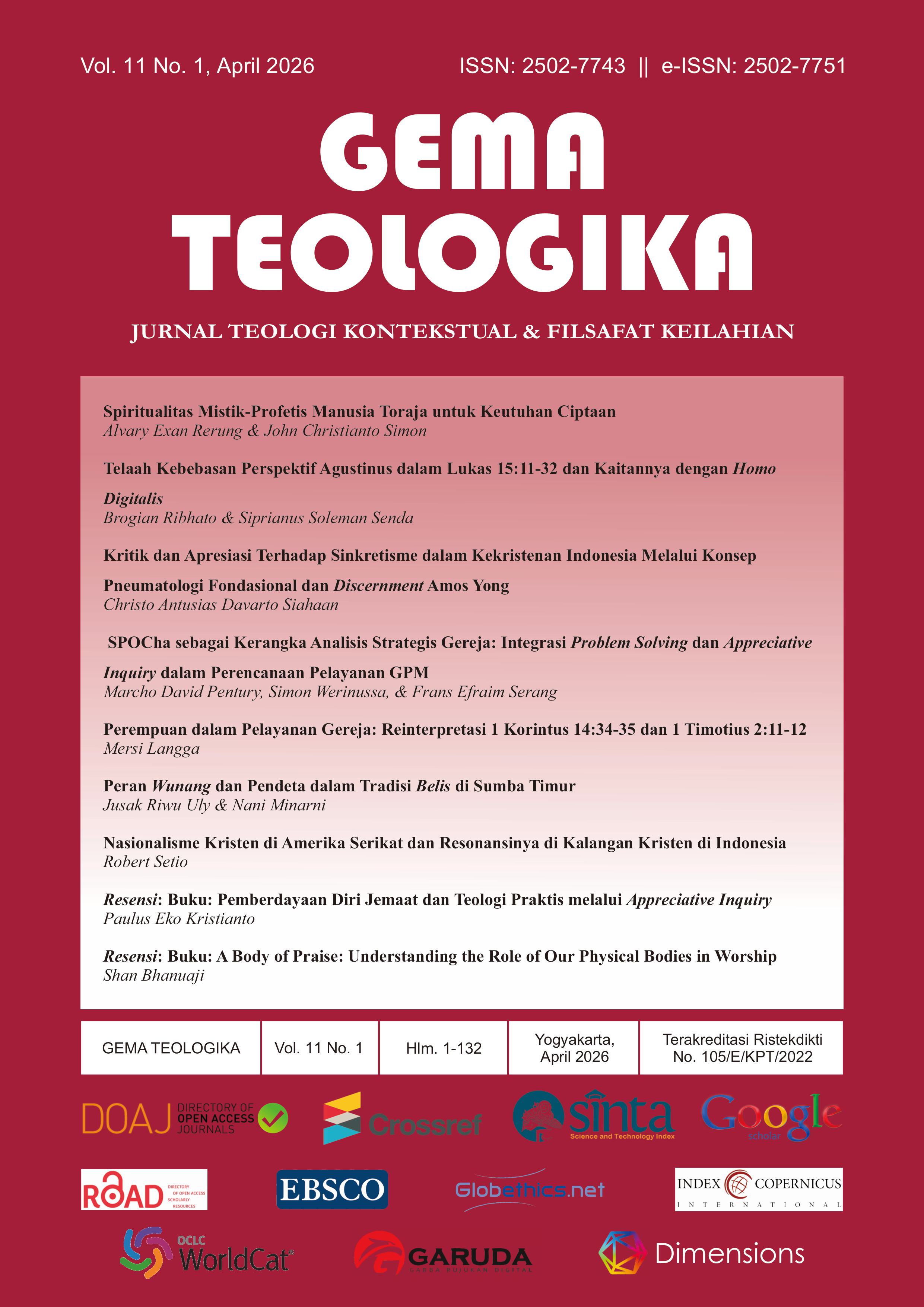
SPOCha sebagai Teknik Analisis Strategis Gereja: Integrasi Problem Solving dan Appreciative Inquiry dalam Perencanaan Pelayanan GPM
DOI:
https://doi.org/10.21460/gema.2026.111.1519Keywords:
SWOT, SOAR, methodology, SPOCha, church strategic planning, metodologi, perencanaan strategis gerejaAbstract
Abstract
This article proposes SPOCha (Strength, Problem, Opportunity, Challenge) as a new strategic analysis technique for developing ministry planning in The Protestant Church in Maluku (GPM). This model is a synthesis of the Problem Solving (PS) and Appreciative Inquiry (AI) approaches, and a modification of the SWOT and SOAR models. The main critic of PS-SWOT is tendency to focus on weaknesses and threats, while AI-SOAR emphasized the positive potential but risks to ignoring the structural wounds in congregation. SPOCha developed to solve those limitations by integrating four key elements: Strength, Problem, Opportunity and Challenge in a reflective and participatory framework. This technique has been tested limitedly in GPM, and has been proven to be helpful in developing contextual and data-based ministry strategies. Therefore, this article concludes that SPOCha contributes to the development of an integrative, participatory, and theological church planning method, and can be applied in various local service contexts.
Abstrak
Artikel ini membahas integrasi pendekatan SWOT dan SOAR dalam perencanaan pelayanan gereja melalui model analisis strategis yang disebut SPOCha. Selama ini, kedua pendekatan tersebut sering digunakan secara terpisah dalam praktik organisasi. SWOT berangkat dari paradigma problem solving yang menekankan identifikasi kelemahan dan ancaman, sedangkan SOAR berakar pada Appreciative Inquiry yang menekankan kekuatan dan aspirasi. Pemisahan ini berpotensi mengabaikan realitas gereja yang memuat persoalan sekaligus potensi penguatan pelayanan. Penelitian ini menggunakan pendekatan kualitatif melalui studi literatur dan analisis kritis terhadap paradigma metodologis yang melandasi SWOT dan SOAR. Hasil analisis digunakan untuk merumuskan model integratif dalam konteks gereja. Artikel ini mengusulkan SPOCha sebagai kerangka metodologis yang menggabungkan kedua pendekatan tersebut. Hasil kajian menunjukkan bahwa integrasi kedua paradigma, membantu menganalisis dan menginterpretasi realitas pelayanan gereja yang tidak hanya memperhatikan dimensi empiris, tetapi juga aspek etis, spiritual, dan teologis yang membentuk kehidupan dan panggilan gereja.
Downloads
Published
Issue
Section
License
Authors who publish with this journal agree to the following terms:
Authors retain copyright and grant the journal right of first publication with the work simultaneously licensed under a Creative Commons Attribution License that allows others to share the work with an acknowledgement of the work's authorship and initial publication in this journal.
Authors are able to enter into separate, additional contractual arrangements for the non-exclusive distribution of the journal's published version of the work (e.g., post it to an institutional repository or publish it in a book), with an acknowledgement of its initial publication in this journal.
Authors are permitted and encouraged to post their work online (e.g., in institutional repositories or on their website) prior to and during the submission process, as it can lead to productive exchanges, as well as earlier and greater citation of published work.