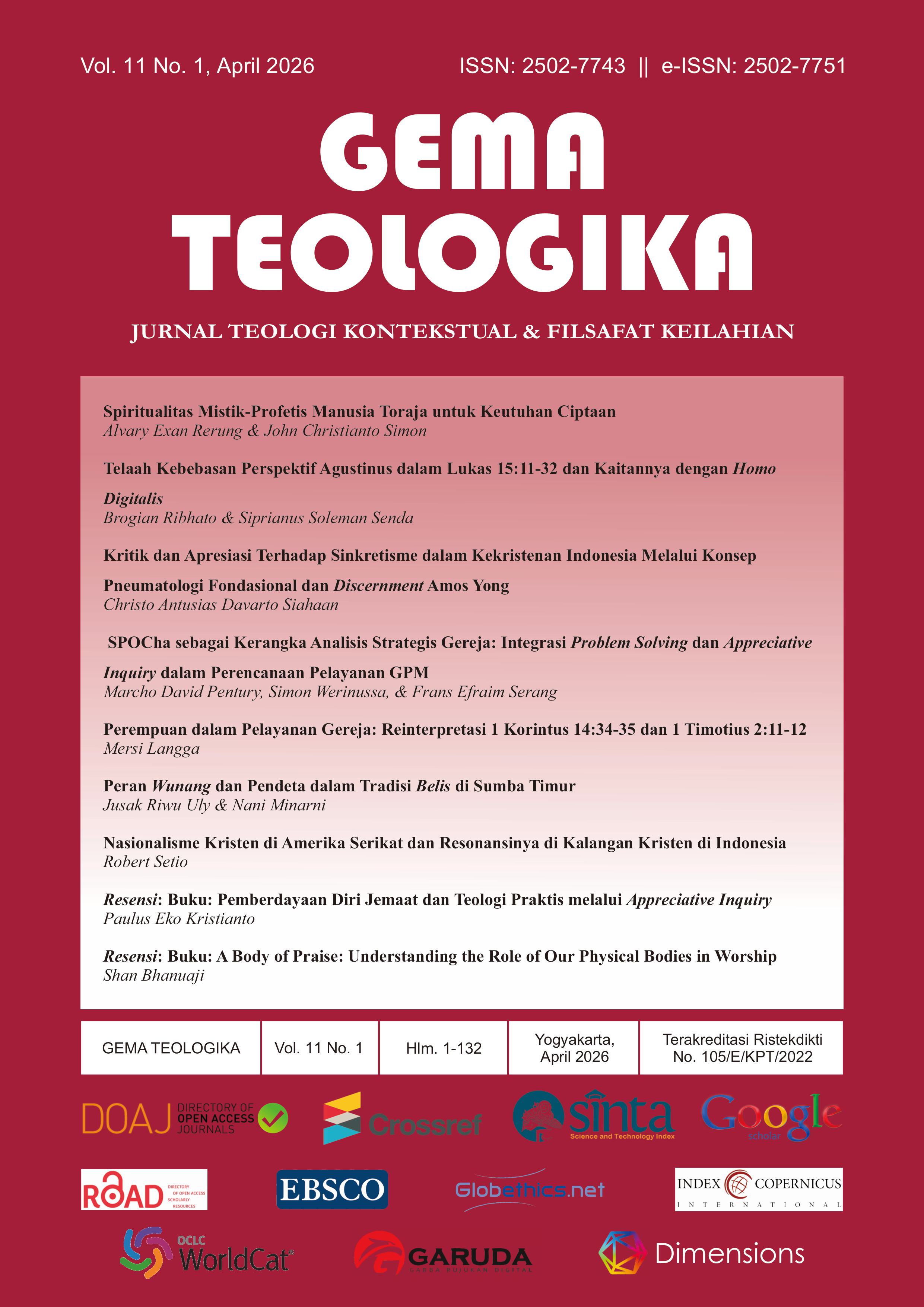
Telaah Kebebasan Perspektif Agustinus dalam Lukas 15:11-32 dan Kaitannya dengan Homo Digitalis
DOI:
https://doi.org/10.21460/gema.2026.111.1266Keywords:
freedom, Homo Digitalis, the youngest child, kebebasan, anak bungsuAbstract
Abstract
A narrow understanding of freedom—namely, freedom from all laws and norms—leads humans into disorientation. This can be observed in Homo Digitalis, who regard themselves as free individuals. In this article, the author seeks to challenge this view by examining the concept of freedom in Homo Digitalis and in the youngest son in Luke 15:11–32, analyzed through Augustine’s perspective. This article employs a literature-based method. The results indicate that both Homo Digitalis and the youngest son are not truly free, as freedom is understood as a state of volition that culminates in virtue. Consequently, it can be argued that Homo Digitalis represents the character of the youngest son in the parable of the prodigal son.
Abstrak
Pandangan tentang konsep kebebasan secara sempit yakni merdeka dari segala hukum dan norma membawa manusia pada disorientasi nilai. Hal itu bisa dilihat dalam diri Homo Digitalis yang menganggap diri sebagai orang-orang yang bebas. Dalam artikel ini penulis berusaha untuk menyangkal pandangan itu dengan menelaah kebebasan Homo Digitalis dan anak bungsu dalam teks Lukas 15:11-32 dan menganalisisnya dengan menggunakan perspektif Agustinus. Penulisan artikel ini menggunakan metode kepustakaan. Hasilnya menunjukkan bahwa baik Homo Digitalis maupun anak bungsu bukanlah orang-orang yang bebas, karena kebebasan selalu dimengerti sebagai status kehendak yang mengarah kepada kebaikan. Oleh karena itu dapat dikatakan bahwa Homo Digitalis merupakan representasi tokoh anak bungsu dalam kisah anak yang hilang.
Downloads
Published
Issue
Section
License
Authors who publish with this journal agree to the following terms:
Authors retain copyright and grant the journal right of first publication with the work simultaneously licensed under a Creative Commons Attribution License that allows others to share the work with an acknowledgement of the work's authorship and initial publication in this journal.
Authors are able to enter into separate, additional contractual arrangements for the non-exclusive distribution of the journal's published version of the work (e.g., post it to an institutional repository or publish it in a book), with an acknowledgement of its initial publication in this journal.
Authors are permitted and encouraged to post their work online (e.g., in institutional repositories or on their website) prior to and during the submission process, as it can lead to productive exchanges, as well as earlier and greater citation of published work.