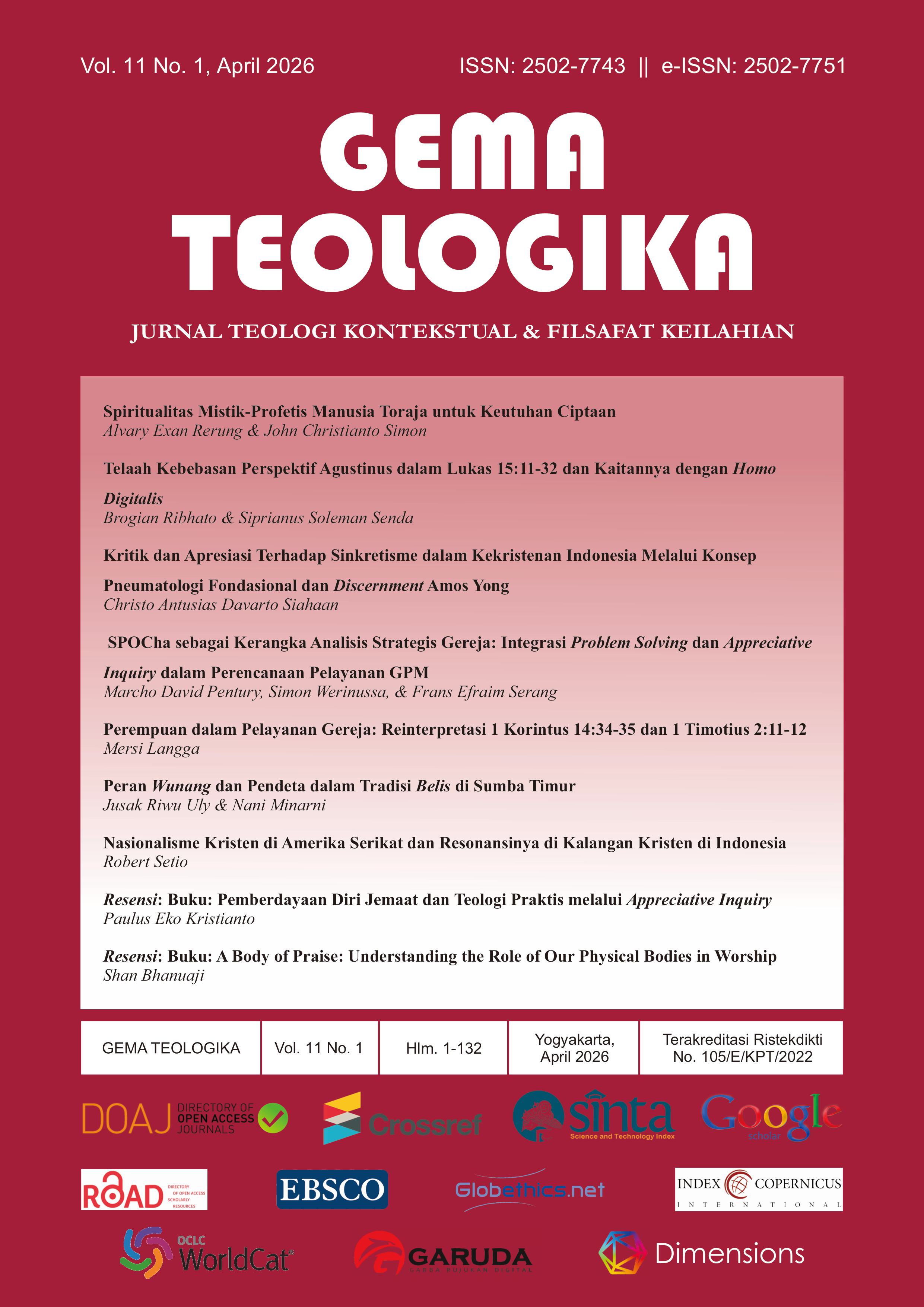
Nasionalisme Kristen di Amerika Serikatdan Resonansinya di Kalangan Kristen Indonesia
DOI:
https://doi.org/10.21460/gema.2026.111.1641Keywords:
nasionalisme Kristen, dominionisme, Kristen pro-Israel, akhir zaman, kritik teologi-ideologi, Christian nationalism, dominionism, Christian pro-Israel, end of time, theological-ideological critiqueAbstract
Abstrak
Nasionalisme Kristen di Amerika Serikat telah muncul sebagai ideologi yang berpengaruh, terutama setelah peristiwa penyerbuan Gedung Capitol (2021) dan kemenangan kedua Donald Trump sebagai presiden. Ideologi ini menggabungkan Kekristenan dengan identitas kebangsaan Amerika. Para pengusung ideologi ini meyakini bahwa AS adalah bangsa Kristen yang harus dipertahankan secara politis dan kultural. Tulisan ini bertujuan untuk memetakan fenomena nasionalisme Kristen di AS, kemudian menganalisis tipologinya, dan mengidentifikasi gejala resonansinya di kalangan Kristen Indonesia. Selain itu, penulis juga akan menyampaikan kritik teologi-ideologi. Penelitian dari tulisan ini menggunakan pendekatan kualitatif studi pustaka dengan metode deskriptif-analitis. Pada bagian kritik teologi-ideologi penulis memakai pemikiran tiga teolog Indonesia: T.B. Simatupang, A.A. Yewangoe, dan E.G. Singgih. Hasil penelitian menunjukkan bahwa nasionalisme Kristen AS memiliki akar sejarah dalam mitos "American exceptionalism" yang berpadu dengan gerakan Moral Majority, dan penyebarannya melalui media konservatif. Di Indonesia, resonansi nasionalisme Kristen tidak bersifat dominasi mayoritas, melainkan adaptasi defensif dari kelompok minoritas yang mengalami diskriminasi, ketidaknetralan negara, dan trauma konflik komunal. Kesimpulannya, nasionalisme Kristen, baik di AS maupun resonansinya di Indonesia, adalah penyimpangan dari iman Kristen yang sesungguhnya. Pelajarannya, gereja di Indonesia dipanggil untuk keluar ke ruang publik dengan sikap melayani, bukan mendominasi.
Abstract
Christian nationalism in the United States has emerged as an influential ideology, most notably witnessed in the Capitol insurrection (2021) and Donald Trump's 2024 victory. This ideology fuses Christianity with American civic identity, believing that the US is a Christian nation that must be preserved politically and culturally. This writing aims to map Christian nationalism in the US, analyze its typologies, identify its resonance among Indonesian Christians, and offer a theological-ideological critique. The research employs a qualitative library-study approach with descriptive-analytical methods and theological-ideological critique, systematically engaging the thought of three Indonesian theologians: T.B. Simatupang, A.A. Yewangoe, and E.G. Singgih. The findings show that US Christian nationalism has historical roots in American exceptionalism, the Moral Majority movement, and conservative media. In Indonesia, the resonance of Christian nationalism does not take the form of majority domination but rather a defensive adaptation of a minority group experiencing discrimination, state partiality, and trauma from communal conflicts. In conclusion, Christian nationalism—both in the US and in its resonance in Indonesia—is a deviation from authentic Christian faith. The church in Indonesia is called to enter the public sphere not to dominate but to serve.
Downloads
Published
Issue
Section
License
Authors who publish with this journal agree to the following terms:
Authors retain copyright and grant the journal right of first publication with the work simultaneously licensed under a Creative Commons Attribution License that allows others to share the work with an acknowledgement of the work's authorship and initial publication in this journal.
Authors are able to enter into separate, additional contractual arrangements for the non-exclusive distribution of the journal's published version of the work (e.g., post it to an institutional repository or publish it in a book), with an acknowledgement of its initial publication in this journal.
Authors are permitted and encouraged to post their work online (e.g., in institutional repositories or on their website) prior to and during the submission process, as it can lead to productive exchanges, as well as earlier and greater citation of published work.